es
es fr
fr de
de nl
nl en
en it
it pt
pt ro
ro sv
sv ru
ru hr
hr da
da si
si pl
pl no
no cs
cs fi
fi el
el sr
srOne of the main concerns when buying a spa is determining its cost and assessing its impact on the home's energy bill. When purchasing a spa, several elements can be configured to optimize its energy efficiency. These include insulation, such as the Ecospa or Nordic Insulation systems, the cover that comes standard on all our spas , the energy consumption of the pumps (the more pumps, the higher the electricity consumption), and, of course, the spa's heating system. In this article, we will focus on the impact of the heating system on energy consumption and explore how to make the most of this new heat pump technology in spas .
The advantages of a heat pump in your spa
Installing a heat pump in your spa will undoubtedly bring you many advantages. Here are a few:
- Constant temperature : A heat pump will allow you to maintain a constant water temperature in your spa . This means you can enjoy your spa at any time, without worrying about changes in ambient air temperature.
- Energy saving: Heat pumps are very efficient compared to other spa heating systems. This results in lower energy consumption, which helps reduce your energy bill in the long run.
- Convenience: Thanks to the heat pumps' ability to heat the water quickly, you won't have to wait long to enjoy your spa. The perfect temperature will be reached in no time, allowing you to soak and relax without unnecessary delay.
- Durability: Heat pumps are designed to be durable and resistant to various weather conditions . This means you can rely on a dependable and long-lasting system for your spa.
- Low maintenance: In general, heat pumps require little maintenance. This gives you the advantage of enjoying your spa without having to constantly worry about the system's operation.
In summary, installing a heat pump in your spa will provide you with a more comfortable, efficient and economical experience, allowing you to fully enjoy the relaxing benefits of your spa.
.webp "pump consumption")
How much can a heat pump save my spa?
Calculating the savings achieved by installing a heat pump in your spa depends on several factors , such as the efficiency of the pump, the cost of electricity, the ambient temperature, and the frequency of spa use.
In general, a heat pump offers significant savings compared to standard electric heating. Conservative estimates indicate that you can save 50 to 70% on energy costs by using a heat pump instead of a 3 kW electric heater.
It's important to consider both short-term and long-term savings. While the initial investment for installing a heat pump may be higher, long-term energy savings can offset this difference. Furthermore, heat pumps generally have a longer lifespan and require less maintenance than electric heaters.
To get a more accurate estimate of the savings you could achieve by installing a heat pump in your spa, I recommend consulting a heating and energy professional who will assess your specific situation and perform the appropriate calculations based on your conditions and energy costs.
Here is a general formula that can be used to calculate savings in euros: Savings in euros = (Energy consumed by the electric resistance - Energy consumed by the heat pump) x Price of electricity.
What would be the economic advantages of installing a heat pump in your spa in terms of savings?
By installing a heat pump in your spa, you can indeed save energy. The key is the pump's coefficient of performance (COP), which represents the ratio between the amount of heat the pump can deliver and the energy required to generate that heat.
In the case of Aquavia spas, the pump has a COP of:
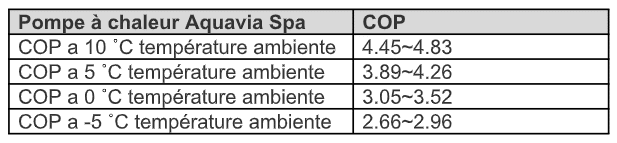
This means that, for example, at an ambient temperature of 10ºC, for 1.1 kW of energy consumed, the heat pump provides between 4.45 and 4.83 kW of heat, compared to an electric resistance which always consumes and provides 3 kW.
Thanks to this factor, the time required to heat the spa water is reduced, which reduces the energy cost of maintaining the water at the recommended temperature of 36.5ºC to enjoy a hydromassage bath.
Important factors to consider
There are several important things to keep in mind:
- Our heat pump is fully integrated into the control panel , allowing you to easily control it from your spa.
- The Aquavia pump can heat or cool the spa water.
- The maximum power of the pump is 5 kW .
- Average energy savings from the heat pump range from 50% to 70%, depending on external conditions and spa insulation.
- All our pump spas are equipped with an additional electric heating element which is activated in case of very low temperatures.
- If you wish to install a pump in your existing spa, it is recommended to contact an installer , as some plumbing and electronic modifications are required.
- Pump maintenance is simple, but it is recommended to have it inspected and serviced at least once a year by a qualified technician to ensure safe and efficient operation.
In summary, choosing a heat pump for your new AquaviaSpa is an excellent choice if you want to save energy. This system is more efficient than a traditional electric heater, which will allow you to reduce your spa maintenance costs. Combined with good insulation, it will save you money every day on your spa's use.